A Global Conservative Wave Is Rising
Professor Zhang Jiawei Discusses the Milei Experiment, American National Conservatism, and Canada at a Crossroads in Vancouver
Watch the Replay on AOCC YouTube Channel
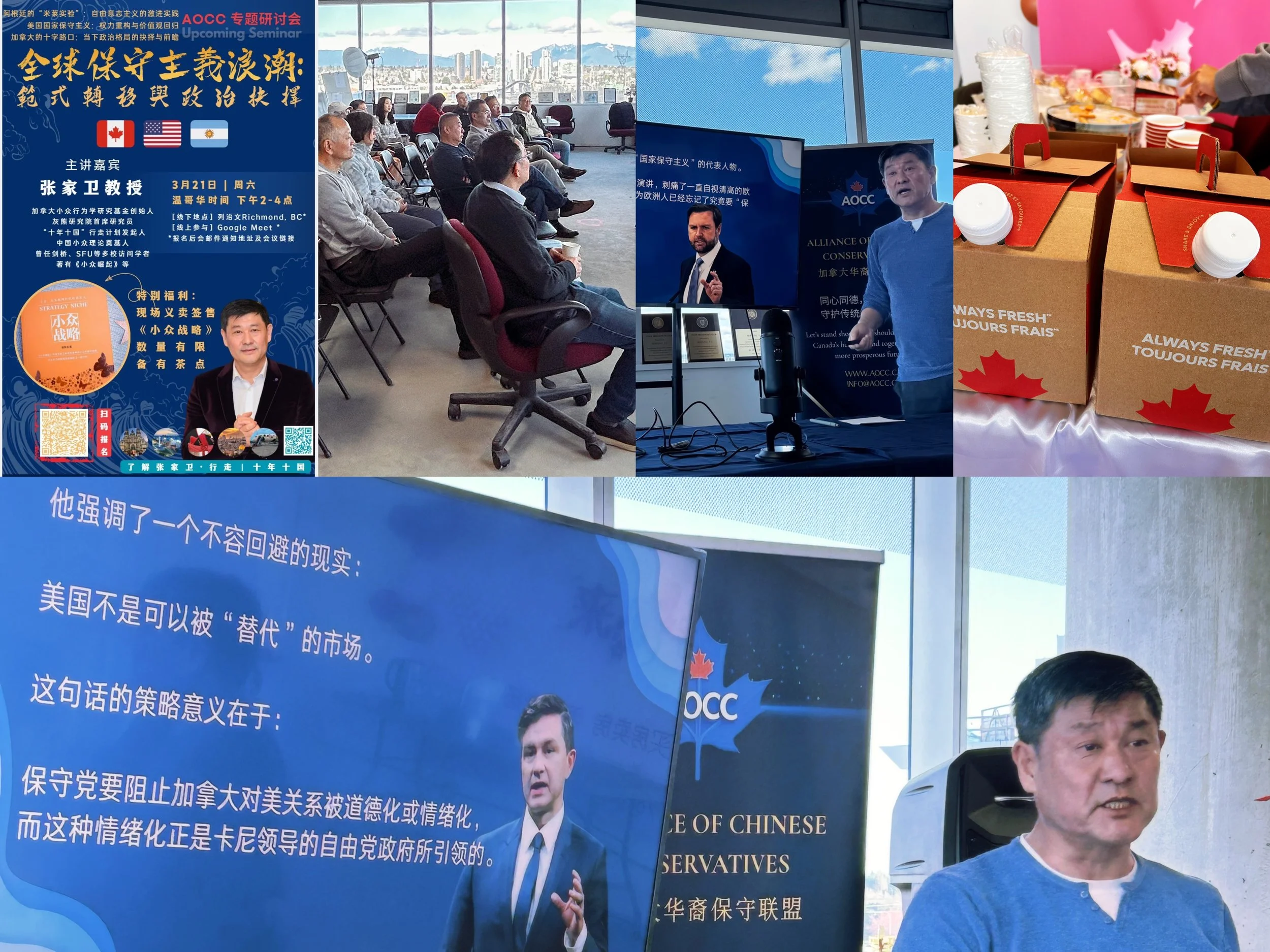
Richmond, British Columbia | March 22, 2026 — On Saturday, March 21, the Alliance of Chinese Conservatives (AOCC) successfully hosted a seminar titled “The Global Conservative Wave: Paradigm Shift and Political Choice.” Held in a hybrid format, the event brought together participants both in person in Richmond, British Columbia, and online via Google Meet. The seminar attracted Chinese Canadian conservatives, scholars, and community members, and was met with strong engagement and enthusiastic response.
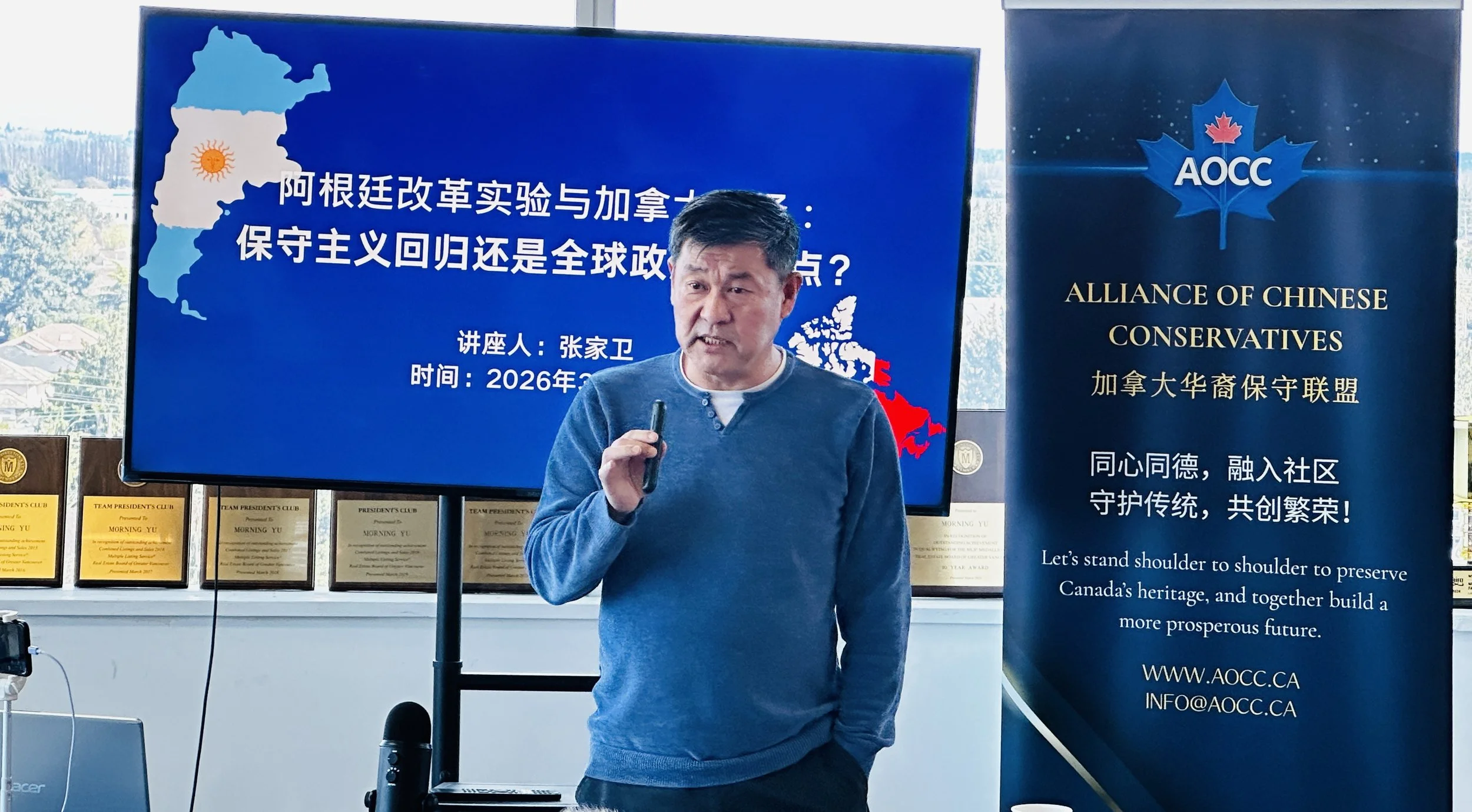
The seminar featured Professor Zhang Jiawei as keynote speaker. In his presentation, Professor Zhang offered a detailed analysis of Argentine President Javier Milei’s radical economic reform agenda and contrasted it with Canadian Prime Minister Mark Carney’s “values-driven” approach to governance. He also commented on Conservative Party leader Pierre Poilievre’s February 26 speech at the Economic Club of Canada in Toronto, prompting thoughtful discussion on the broader global political realignment and the future of Canada–U.S. relations.
Professor Zhang began by examining the major developments and policy outcomes of the Milei government over the past two years. He described Milei—an economist, political outsider, and advocate of free-market reform—as a figure who has pursued not merely the creation of a new political order, but the rebuilding of a nation through the restoration of core conservative principles. He noted Milei’s strong identification with conservative values, as well as his visible participation in international conservative gatherings such as CPAC, which has reinforced Argentina’s place within a broader global conservative trend.
Professor Zhang then situated Argentina’s developments within a wider international context. He argued that the United States is undergoing a significant ideological shift from traditional neoconservatism toward National Conservatism. In his view, this movement—associated with figures such as Donald Trump, JD Vance, Javier Milei, Giorgia Meloni, and influential technology leaders such as Peter Thiel and Elon Musk—places national interest at the center of political life, resists excessive globalization and cultural individualism, and critiques the liberal policy consensus of the last four decades for weakening the middle class and undermining the traditional family. Citing the observations of thinkers such as Liu Junning, Professor Zhang suggested that this movement should not be understood simply as populism, but rather as a mainstream corrective response to what many perceive as a prolonged leftward drift in Western politics.
In contrast, Professor Zhang offered a critical assessment of the Carney government’s governing philosophy, which he linked to the ideas expressed in Carney’s 2021 book Value(s). He characterized this vision as a form of values-driven capitalism, in which market prices are not allowed to override social values, markets are to be re-embedded within society, and climate change is treated as the defining example of market failure. He pointed to the Carney government’s 2025 budget commitment of C$1 trillion in public investment over five years, focused on housing, infrastructure, defence, and productivity, but argued that such an approach risks masking deeper structural weakness in the private sector through debt-fuelled expansion. He further noted that public spending growth has outpaced GDP growth and warned that this trajectory could constrain private investment over time. Professor Zhang also raised concerns that certain left-leaning policy directions—including ongoing disputes over land rights—may weaken the foundations of private property, while anti-American rhetoric is increasingly being used to maintain political support.
In the latter portion of the seminar, Professor Zhang turned specifically to Pierre Poilievre’s February 26 speech at the Economic Club of Canada. He highlighted Poilievre’s pragmatic language regarding the United States, including the view that “the American people are not our enemy” and that Canada should not seek a permanent rupture with its largest trading partner. Professor Zhang praised this position for recognizing the indispensable central role of Canada–U.S. relations, and for treating trade diversification as a supplement to, rather than a replacement for, the bilateral relationship. In his view, this approach helps prevent Canada’s relationship with the United States from being framed in purely moral or emotional terms. He described Poilievre’s position as a realistic and strategically grounded Canadian policy, and contrasted it with what he regarded as the Carney government’s rhetoric of multilateral substitution and risk redistribution.
At the same time, Professor Zhang offered strategic observations for the Conservative movement in Canada. He argued that the Conservative Party would benefit from adopting a more clearly defined and unapologetic political identity, particularly on issues such as drug policy, limiting the excesses of LGBTQ-related issues, and relations with the United States. In his view, greater alignment with the broader current of National Conservatism—and a clearer break from older neoconservative habits—would strengthen the party’s credibility and appeal. In his view, the success of Milei, Trump, and, more recently, the president of Chile all stemmed from uncompromising clarity of position, which in turn won the trust of centrists and the broader public.
Professor Zhang closed with a forceful reflection on the broader political moment. He argued that the world is facing deep disorder, and that periods of profound crisis require serious remedies. Referring to Argentina’s experience under Milei, he suggested that democratic societies still possess the capacity for renewal when silent majorities choose to act through the ballot box. Speaking also from his own experience as a resident of British Columbia, he expressed concern over the divisive effects of left-wing politics in Western society and voiced support for both the federal Conservative Party and the Conservative Party of British Columbia.
The seminar was met with sustained applause, and many attendees remarked that the discussion significantly deepened their understanding of the global conservative movement while strengthening their sense of political clarity and civic purpose. AOCC reaffirmed its commitment to building high-quality platforms for ideas, dialogue, and public engagement, and to bringing together Chinese conservative voices in pursuit of a stronger and more prosperous future for Canada.