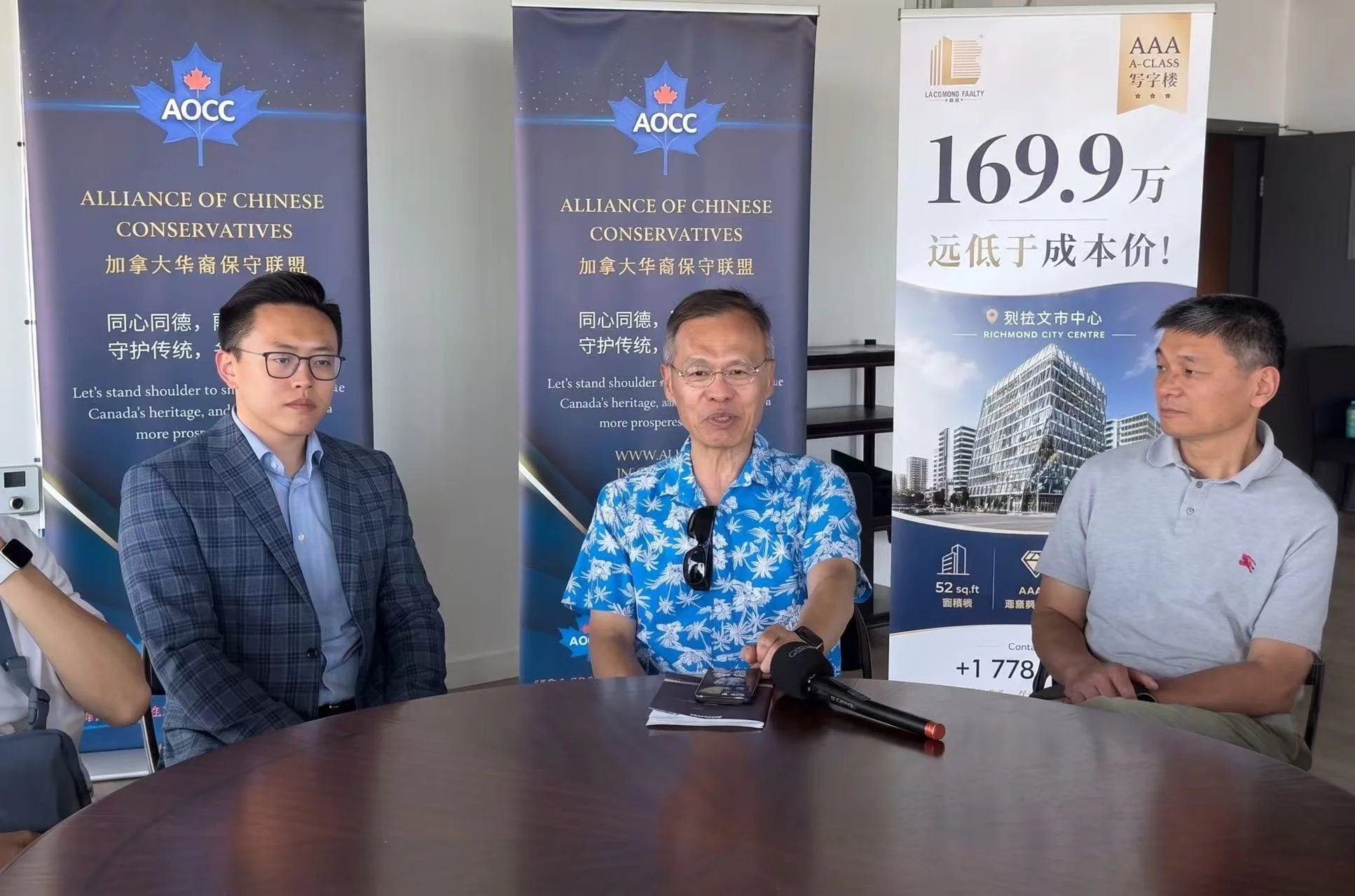
Building Momentum and Looking Ahead: AOCC Hosts Successful Forum to Unite the Chinese Canadian Community for Future Provincial Elections

[Richmond, BC] — On June 14, 2026, the Alliance of Chinese Conservatives (AOCC) successfully hosted the “Building Momentum and Looking Ahead” forum in Richmond. Participants engaged in in-depth discussions on the recent BC Conservative Party leadership election, proactive interactions between federal and provincial conservatives, responses to political attacks by the governing NDP, and pathways for greater Chinese Canadian civic and political engagement.
1. Leadership Election and Unity Across Factions: A Grassroots Movement Where Every Vote Counts
Former federal cabinet minister Kerry-Lynne Findlay was elected Leader of the BC Conservative Party. During the leadership race, party membership experienced explosive growth, increasing nearly sixfold in less than five months—from approximately 7,000 members to more than 42,000.
Although Findlay ultimately secured victory in the fourth round by a narrow margin of 51% to 49%, and divisions emerged during the campaign, forum participants emphasized that conservatives share the same fundamental principles and goals. In an election that could have been decided by only a few dozen votes, the Chinese Canadian community must promote unity across different factions and bring everyone back to the table to strengthen the broader conservative movement.
2. Proactive Interactions Between Federal and Provincial Conservatives: A Rare Political Development
As the BC Conservative leadership race intensified, several federal Conservative Members of Parliament, including MP Chak Au, Chair of the Conservative Pacific Gateway Economic Engagement Caucus, publicly endorsed Kerry-Lynne Findlay and contributed to the momentum behind her successful campaign. Following her victory, federal Conservative leader Pierre Poilievre and former Prime Minister Stephen Harper also offered high-profile congratulations, demonstrating an unprecedented level of strategic cooperation between federal and provincial conservative forces.
These developments suggest that the BC Conservative Party’s policy direction is increasingly aligning with the federal Conservative vision of “Common Sense Conservatism.” On key issues such as combating the drug crisis, reducing crime, protecting property rights, defending parental rights, and advancing responsible resource development, the two parties have demonstrated significant policy alignment.
From a broader perspective, British Columbia serves as Canada's gateway to the Asia-Pacific region. Should both the federal government and the BC government eventually be led by conservatives, policy coordination in areas such as economic development, resource project approvals, infrastructure investment, and trans-Pacific trade could be significantly strengthened. In such a scenario, British Columbia would not only become the federal Conservative movement’s most important strategic foothold on the West Coast but could also emerge as a major engine for economic growth, international trade expansion, and enhanced national competitiveness.
For Canada's conservative movement, this level of mutual support, policy coordination, and strategic cooperation between federal and provincial conservatives is uncommon in recent political history and may signal the emergence of a more comprehensive and coherent conservative governing vision.
3. Responding to NDP and Media Attacks: Rejecting Labels and Refocusing on Everyday Issues
The forum examined what participants described as efforts by the NDP and mainstream media outlets, including CBC, to focus on personal attacks rather than policy debates. Examples discussed included characterizing interprovincial cooperation as “MAGA regional management,” making unfounded allegations of racism against the new party leader, creating dedicated platforms to promote long-term “Trump-style” narratives, and misrepresenting property rights policies through selective or misleading interpretations.
Participants emphasized the importance of countering stereotypes and political labels by returning the conversation to issues that directly affect British Columbians' daily lives.
4. Outlook for the Next Provincial Election: Capitalizing on Key Battleground Ridings
Recent polling indicates that the BC Conservative Party has, for the first time, moved ahead of the governing NDP, with support at 45% compared to the NDP’s 41%.
In the last provincial election, the NDP secured government by only narrow margins in several key ridings. In Surrey-Guildford, for example, the difference between the two major parties was just 22 votes. Many of these highly competitive ridings—where elections can be decided by a few dozen or a few hundred votes—are concentrated in Metro Vancouver communities with significant Chinese Canadian populations, including Vancouver, Surrey, Burnaby, Richmond, and Coquitlam.
The forum concluded that Chinese Canadian voters possess the potential to play a decisive role in determining electoral outcomes in these critical constituencies.
Conclusion
The forum called upon Chinese Canadian voters to engage actively in the political process by focusing on issues that directly affect their families and communities, including the drug crisis, public safety, affordability, property rights, and children's education. Participants were encouraged to move progressively along the ladder of civic engagement—from staying informed, to voting, to joining political parties, and ultimately to seeking public office. With by-elections and future provincial elections on the horizon, the message was clear: Chinese Canadians must prepare now to ensure their voices are heard and represented in the legislature.